Last Updated: 12 August 2026
DPSACircular.co.za is committed to providing accurate, useful and transparent employment information for South African job seekers.
Because government vacancy information changes over time, an article might require a correction, clarification or update after publication. A government department might amend a vacancy, change a closing date, withdraw a position, correct an error or publish a new official notice.
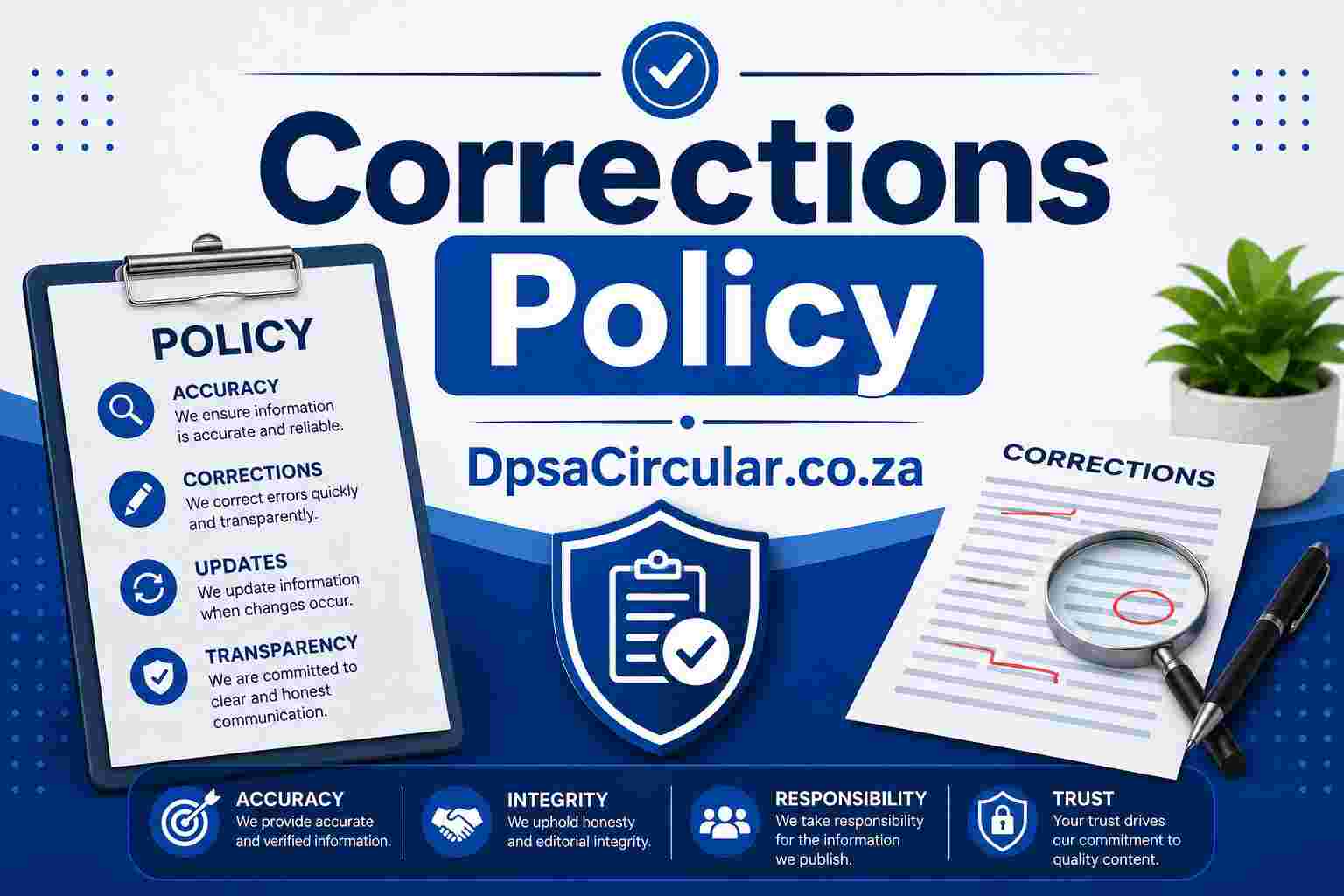
This Corrections Policy explains how DPSACircular.co.za identifies, reviews and corrects factual errors and outdated information.
1. Our Commitment to Accuracy
We aim to provide accurate and useful information about:
- DPSA Vacancy Circulars
- Government vacancies
- Government internships
- Learnerships
- Graduate programmes
- Bursaries
- Public sector employment opportunities
- Government application procedures
- Z83 application information
- Public service career guidance
We understand that inaccurate employment information might affect a person’s ability to apply for a position.
For this reason, we take reported errors seriously and review factual concerns when reliable supporting information is available.
2. What We Consider a Correction
A correction is a change made to published information because the original information was inaccurate, incomplete or misleading.
Examples include an incorrect:
- Job title
- Reference number
- Salary
- Salary level
- Qualification requirement
- Experience requirement
- Job location
- Closing date
- Application method
- Required document
- Department name
- Contact detail
- Vacancy status
- Application instruction
- Official source link
A correction might also be required when an article incorrectly describes information contained in an official government advertisement.
3. Corrections Versus Updates
We distinguish between corrections and ordinary updates.
A correction addresses information previously published incorrectly.
An update adds new or changed information that was not necessarily incorrect when originally published.
For example:
If an article originally states the correct closing date of 24 August 2026 and the department later changes the closing date to 31 August 2026, this is an update based on a new official notice.
If our article incorrectly states that the original closing date was 31 August 2026 when the official advertisement stated 24 August 2026, this is a correction.
This distinction helps readers understand why information on a page has changed.
4. How We Identify Errors
Errors might be identified through:
- Our editorial review
- Official government notices
- Amended vacancy advertisements
- Updated government PDFs
- Government department websites
- Official recruitment portals
- Reader reports
- Broken or changed official links
- Other reliable sources
We give priority to information from the relevant official government department or public institution when determining the current status of a vacancy.
5. How We Review Reported Errors
When we receive a correction request, we review the information against reliable evidence.
Our review might include checking:
- The original vacancy advertisement
- The latest official vacancy PDF
- An amended government advertisement
- The relevant government department website
- An official recruitment portal
- An official government notice
- Other reliable supporting sources
We aim to avoid making changes based solely on unsupported claims or information from an unverified third-party source.
6. Official Sources Take Priority
For government vacancies, the relevant government department or public institution remains the primary authority for recruitment information.
If information published on DPSACircular.co.za differs from a current official government advertisement, readers should follow the current official source.
When we identify a verified difference, we review our article and make an appropriate correction or update.
DPSACircular.co.za does not override, replace or alter official government recruitment information.
Our role is to explain publicly available employment information and help readers understand the relevant recruitment process.
7. How We Correct Published Articles
When an error is confirmed, we correct the affected information.
Depending on the nature of the error, we might:
- Correct the inaccurate statement
- Add a clarification
- Update the vacancy details
- Replace an outdated closing date
- Correct a job title
- Correct a reference number
- Update an application instruction
- Replace a broken official link
- Add information from an amended advertisement
- Mark a vacancy as closed
- Add an editorial clarification
We aim to correct information in a way that leaves the page clear and useful for readers.
8. Significant Corrections
For significant factual errors, we aim to provide additional transparency where appropriate.
A significant correction might involve:
- A materially incorrect closing date
- Incorrect salary information
- Incorrect qualification requirements
- Incorrect application instructions
- An incorrect claim about vacancy availability
- A wrong department or institution
- A misleading statement about eligibility
- A major error in the number of advertised positions
Where appropriate, we might include a short correction statement or explanation on the affected page.
9. Minor Corrections
Not every change requires a formal correction notice.
Minor corrections might include:
- Spelling mistakes
- Grammar errors
- Formatting problems
- Typographical errors
- Broken internal links
- Minor wording improvements
- Formatting inconsistencies
We might correct these issues without adding a separate correction notice.
The purpose of this approach is to keep pages accurate and readable without creating unnecessary notices for insignificant changes.
10. Closing Date Corrections
Closing dates receive particular attention because they directly affect a reader’s ability to submit an application.
When a government department changes a closing date through an official notice, we aim to update the relevant article as soon as reasonably possible after becoming aware of the change.
If a vacancy has already closed, we aim to make the status clear.
We do not intentionally present an expired vacancy as a current opportunity.
Readers should always confirm the closing date in the latest official advertisement before applying.
11. Amended Vacancy Advertisements
A government department might issue an amended advertisement after publishing the original vacancy.
When we become aware of an amended advertisement, we review the relevant article.
Depending on the change, we might:
- Update the affected information
- Add a clarification
- Link to the amended official source
- Update the closing date
- Explain the change
- Mark the previous information as superseded
Where the amended official advertisement conflicts with an earlier version, the latest applicable official information takes priority.
12. Withdrawn Vacancies
Government departments sometimes withdraw advertised positions.
When we receive reliable confirmation that a vacancy has been withdrawn, we aim to update the relevant page.
We might identify the vacancy as withdrawn or closed and explain the status where sufficient official information is available.
We do not knowingly continue presenting a withdrawn vacancy as an active opportunity.
13. Expired Vacancy Pages
DPSACircular.co.za might retain older vacancy pages after their closing dates.
Older pages can provide useful reference information about previous government recruitment opportunities, salary levels, job requirements and application procedures.
When a vacancy has closed, we aim to make the status clear.
We do not change an old vacancy into a current opportunity simply to attract search traffic.
14. Updated Dates
We use publication and update dates to help readers understand when an article was published and when meaningful changes were made.
An updated date should reflect a genuine content update.
We do not change an article’s date solely to make unchanged content appear recent.
Where structured data is used, dates should accurately represent the visible publication or modification information on the page.
Google recommends providing clear dates and using accurate datePublished and dateModified information when structured data is implemented.
15. Reader Correction Requests
Readers are welcome to report factual errors.
When reporting a correction, please provide:
- The page URL
- The information you believe is incorrect
- The corrected information
- The reason for the correction
- A link to the relevant official source, where available
A source from the relevant government department is especially useful for vacancy-related corrections.
Providing evidence helps us review the issue accurately.
16. How We Handle Unsupported Reports
We review correction requests based on available evidence.
A correction request might not result in a change when:
- The claim cannot be verified
- The supporting information is unreliable
- The official source contradicts the requested change
- The reported issue is a matter of opinion rather than fact
- The information relates to an individual’s private information
- The request seeks to remove accurate information without a valid basis
We aim to make editorial decisions based on reliable information rather than pressure from individuals or organisations.
17. Correction Requests From Government Departments
If a government department or public institution contacts us about an article, we review the information provided.
Where the department provides reliable evidence showing that published information is inaccurate or outdated, we review the relevant page and make an appropriate correction or update.
We do not present DPSACircular.co.za as an official government communication channel.
Where appropriate, we direct readers to the department’s official source for confirmation.
18. Source Verification
Our correction process prioritises reliable sources.
For government vacancies, preferred sources include:
- Official government department websites
- Official government vacancy PDFs
- Official DPSA publications
- Official recruitment portals
- Official government notices
- Official public institution websites
Third-party websites might help identify information requiring review, but an official source takes priority when one is available.
19. Correction History
We do not need to create a separate visible correction log for every minor spelling or formatting correction.
For significant changes, we aim to provide enough context for readers to understand the current information.
Where appropriate, an article might include wording such as:
“Updated after the relevant department published an amended vacancy notice.”
or:
“Correction: The closing date has been updated to reflect the latest official advertisement.”
The exact wording depends on the nature of the change.
20. Accuracy of Archived Information
Archived articles are historical records of information published at a particular time.
Information in an archived article might no longer represent the current recruitment situation.
Where practical, we identify expired or closed vacancies so readers understand the status of the opportunity.
Readers should not rely on an old article when an updated official advertisement is available.
21. Corrections to Career Guides
Corrections also apply to evergreen career and application guides.
We review guides when we identify:
- Incorrect application information
- Outdated government procedures
- Incorrect Z83 information
- Outdated terminology
- Incorrect references
- Broken official links
- Changes in relevant public service processes
Where significant changes occur, we update the relevant guide.
22. AI-Assisted Content and Corrections
DPSACircular.co.za might use artificial intelligence and other digital tools during parts of the research, organisation, editing or publishing process.
The use of such tools does not remove editorial responsibility.
If an AI-assisted process contributes to an inaccurate statement, the publisher remains responsible for reviewing and correcting the published information.
We do not rely on automated content generation as a substitute for checking important government vacancy information.
Google’s current guidance states that AI-generated content should provide value to users and warns against generating many pages without adding value, which might fall under scaled content abuse.
Our corrections process therefore applies to all published information regardless of which tools were used during production.
23. Search Engine Transparency
Our corrections process is designed for readers first.
We do not make corrections solely to manipulate Google, Bing or other search engines.
We aim to keep published information accurate, useful and understandable for people.
Search visibility does not determine whether a factual error should be corrected.
Google’s current guidance prioritises helpful, reliable, people-first content rather than content created primarily to manipulate search rankings.
Bing’s Webmaster Guidelines likewise evaluate content for quality, relevance and accessibility and apply across Bing Search and newer AI experiences.
24. No Paid Corrections
DPSACircular.co.za does not sell editorial corrections.
A person or organisation does not need to pay us to correct a genuine factual error.
Editorial decisions are based on accuracy, reliable evidence and the interests of readers.
Advertising or commercial relationships do not determine whether an accurate correction is made.
25. Protection of Personal Information
Correction requests should not include unnecessary personal information.
Please do not send:
- Passwords
- Banking passwords
- Full payment card details
- Unnecessary identity documents
- Private account credentials
- Sensitive personal information
If supporting evidence contains personal information that is not necessary for the correction, please remove or redact such information where possible.
Our Privacy Policy explains how information submitted through the website is handled.
26. How Quickly Do We Make Corrections?
We aim to review important correction reports as soon as reasonably possible.
The timing depends on:
- The seriousness of the reported error
- Availability of reliable evidence
- Whether an official source needs to be checked
- Whether a government department has issued a correction
- The complexity of the issue
We do not promise a fixed correction timeframe because some issues require additional verification.
27. Reader Notification
We do not normally contact every reader who has previously viewed an article after making a correction.
Instead, we update the relevant page so future readers see the corrected information.
For significant changes, we might include a correction or update notice on the page.
28. Our Editorial Responsibility
Godwin Samuel, Founder and Publisher of DPSACircular.co.za, is responsible for the site’s editorial standards and correction process.
The publisher oversees:
- Content accuracy
- Source checking
- Corrections
- Updates
- Editorial standards
- Reader feedback
- Publication practices
Information from government departments remains the responsibility of the relevant government institution.
29. Our Relationship With Official Government Sources
DPSACircular.co.za is an independent employment information website.
We are not the official website of:
- The Department of Public Service and Administration
- The South African Government
- Any national government department
- Any provincial government department
- Any government recruitment authority
We report and explain publicly available employment information.
Government departments and public institutions remain responsible for their own vacancies, recruitment procedures, application requirements and recruitment decisions.
30. How to Report a Correction
If you believe an article contains inaccurate or outdated information, contact DPSACircular.co.za through our Contact Us page.
Please include:
Page URL:
Information requiring review:
Suggested correction:
Supporting official source:
Additional explanation:
Providing the official source helps us review the report more efficiently.
31. Our Commitment to Readers
We aim to maintain a correction process based on:
- Accuracy
- Transparency
- Reliable sourcing
- Editorial independence
- Reader usefulness
- Timely updates
- Clear communication
- Responsible publishing
Our objective is to ensure readers have access to information that accurately reflects the available government employment information.
32. Policy Updates
This Corrections Policy might be updated when our editorial processes change or when relevant publishing and search requirements develop.
The latest revision date appears at the top of this page.
We do not change this policy merely to create the appearance of new content.
33. Important Disclaimer
DPSACircular.co.za provides independent employment information.
We do not accept government job applications, shortlist applicants, conduct interviews, guarantee employment or make recruitment decisions.
The relevant government department or public institution remains responsible for its own recruitment information.
Readers should verify important vacancy information through the latest official source before submitting an application.
34. Contact
For corrections, factual concerns, outdated vacancy information or broken official links, please visit our Contact Us page.
DPSACircular.co.za welcomes factual feedback that helps improve the accuracy and usefulness of our employment information.
Related Pages
Founder and Publisher of DPSACircular.co.za “Godwin Samuel
DPSACircular.co.za Trust, Accuracy & Editorial FAQ
Corrections Policy Owner: DPSACircular.co.za
Publisher: Godwin Samuel
Website: DPSACircular.co.za
Policy Type: Editorial Corrections Policy
Last Updated: 12 August 2026