
Posted: 13 August 2026
Last updated: 24 September 2026
Category: Government Jobs, Career Guides, Interview Preparation
Reviewed by / Author: Godwin Samuel, Founder and Publisher, DPSACircular.co.za
Getting shortlisted for a South African government job means your application has passed an important stage of the recruitment process. The next step is often an interview where a selection panel assesses your suitability for the advertised position.
A government interview is different from preparing for a general job interview because your answers should connect directly to the advertised duties, requirements, competencies and the work of the relevant government department.
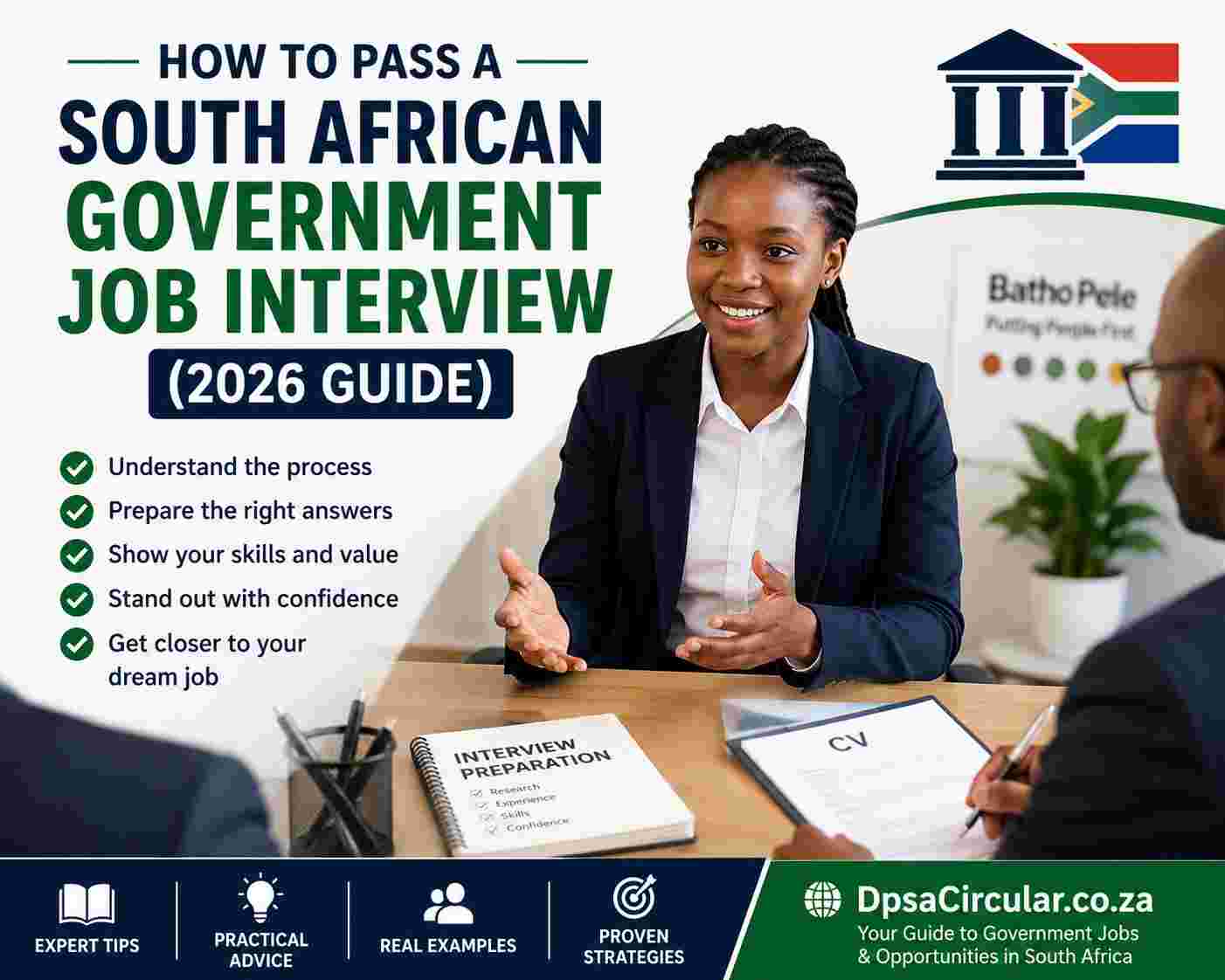
This 2026 guide explains how government job interviews work, what happens after shortlisting, what questions you might face, how to prepare strong answers, what documents to take, how competency-based questions work, what happens after an interview and how you should prepare for different types of public service positions.
The guidance below is designed around people-first content principles, clear sourcing and useful South African government recruitment information. Google states that Search systems prioritise helpful, reliable content created for people, while its current guidance for AI search also recommends unique, valuable, expert-led content rather than search-engine-first material.
Bing’s current Webmaster Guidelines cover traditional search, Copilot and other AI experiences, with emphasis on content quality, relevance, clarity and eligibility for indexing and citations.
Quick Answer: How Do Government Job Interviews Work?
A South African government job interview usually takes place after the recruiting department has reviewed applications and shortlisted suitable candidates.
The process often follows this pattern:
- A government department advertises a vacant position.
- Applicants submit applications according to the vacancy instructions.
- The department assesses applications against the advertised requirements.
- Suitable applicants are shortlisted.
- Shortlisted candidates receive interview information.
- A selection panel asks questions related to the position.
- Candidates are assessed against relevant requirements and competencies.
- Additional assessments or verification processes follow where required.
- The department completes the selection and approval process.
- The successful candidate receives appointment information.
The exact procedure differs according to the department, position and level of the post.
The official DPSA Public Service Vacancy Circular states that the circular contains advertisements for vacant posts in public service departments and that enquiries about a particular advertisement should go to the department responsible for the vacancy.
Table of Contents
- What is a government job interview?
- What happens before a government interview?
- How government shortlisting works
- How interview invitations work
- Who sits on the interview panel?
- What happens when you arrive?
- How the interview starts
- Types of government interview questions
- Competency-based questions
- Technical questions
- Scenario-based questions
- Government department questions
- Public service values and Batho Pele
- How to answer government interview questions
- The STAR method
- How to answer difficult questions
- Government interview preparation using the vacancy advertisement
- Preparing without government experience
- Preparing as a graduate or intern
- Preparing for administrative positions
- Preparing for professional and technical positions
- Preparing for management positions
- Documents to take to an interview
- What to wear
- Online government interviews
- What happens after the interview?
- Verification and suitability checks
- Why recruitment feedback sometimes takes time
- Common interview mistakes
- Seven-day preparation plan
- 25 government interview questions
- Government interview checklist
- How DPSACircular.co.za researches this guide
- Frequently Asked Questions
- About DPSACircular.co.za
- Disclaimer
What Is a Government Job Interview?
A government job interview is a formal assessment used to determine whether shortlisted applicants meet the requirements of a specific public service position.
The panel might assess:
- Qualifications
- Work experience
- Technical knowledge
- Job-related competencies
- Communication
- Problem-solving
- Teamwork
- Professional conduct
- Decision-making
- Public service orientation
- Understanding of the advertised position
The panel should assess you in relation to the vacancy rather than your general ability to answer interview questions.
For this reason, reading the complete vacancy advertisement is one of the most important preparation steps.
What Happens Before a Government Interview?
Before an interview takes place, the department needs to identify suitable applicants from the applications received.
The vacancy advertisement provides the basis for understanding who should be considered.
The DPSA Public Service Vacancy Circular contains government vacancy advertisements and directs applicants to the relevant department for vacancy-specific enquiries.
A typical recruitment sequence includes:
1. Vacancy identification
A department identifies a position requiring recruitment.
2. Advertisement
The department publishes the vacancy through an approved recruitment channel.
3. Application
Applicants submit the required application information before the closing date.
4. Screening
Applications are reviewed against the advertised requirements.
5. Shortlisting
Applicants who meet the requirements are considered for the next stage.
6. Interview
Shortlisted candidates are assessed by an interview panel.
7. Further assessment and verification
Additional processes follow where required.
8. Selection and appointment
The department follows the relevant approval and appointment procedures.
The process differs between positions, so applicants should always follow the specific vacancy advertisement.
How Government Job Shortlisting Works
Shortlisting focuses on the requirements published in the vacancy advertisement.
The department might consider:
- Minimum qualifications
- Required experience
- Relevant skills
- Professional registration
- Knowledge requirements
- Job-specific competencies
- Other conditions listed in the advertisement
Meeting the minimum requirements does not mean every applicant receives an interview.
The department receives applications from multiple candidates and follows the applicable recruitment process to identify candidates for further assessment.
How Government Interview Invitations Work
A shortlisted applicant should receive interview information through the contact details provided during recruitment.
Your invitation might include:
- Position title
- Reference number
- Interview date
- Interview time
- Interview venue
- Online meeting details
- Documents to bring
- Contact information
- Instructions for an additional assessment
Read every instruction carefully.
If the department asks you to confirm attendance, follow the stated instructions.
Do not rely on information from social media comments or unofficial websites when an interview invitation provides different instructions.
Who Sits on the Government Interview Panel?
The composition of an interview panel varies according to the position and department.
A panel might include:
- A chairperson
- A manager from the relevant branch
- Human resources representatives
- Technical representatives
- Other authorised officials
The purpose of the panel is to assess shortlisted candidates against the requirements of the position.
You should therefore prepare for questions from both a general recruitment perspective and a technical perspective.
What Happens When You Arrive at the Interview?
Arrive early enough to complete security, registration and venue procedures.
Bring the items requested by the department.
Your preparation folder might contain:
- Interview invitation
- CV
- Identity document where requested
- Qualification documents where requested
- Professional registration proof where required
- Relevant certificates
- Portfolio or work samples where requested
- Pen and notebook
Do not submit additional personal documents unless the department requests them.
How the Interview Usually Starts
The panel often introduces the interview process before asking questions.
You might receive an opening question such as:
“Please tell us about yourself.”
Do not provide your entire life history.
Focus on information relevant to the advertised position.
A useful introduction includes:
- Your professional background
- Relevant experience
- Important skills
- Relevant qualifications
- Your interest in the position
Example
“My name is GODWIN SAMUEL. I have experience in administration, records management and customer service. My previous responsibilities included maintaining accurate records, responding to enquiries and supporting daily office operations. I applied for this position because my experience matches the administrative duties listed in the advertisement, and I am interested in contributing to effective public service delivery.”
Adapt the example to your real background.
Types of Government Interview Questions
Government interview questions differ according to the position.
The main categories include general, competency-based, technical, scenario-based and department-related questions.
1. General Interview Questions
Examples include:
- Tell us about yourself.
- Why did you apply for this position?
- Why should we appoint you?
- What are your strengths?
- What professional area are you improving?
- What do you know about this department?
- What do you understand about this position?
Keep your answers focused on the advertised job.
2. Competency-Based Questions
Competency questions ask you to describe how you handled a real situation.
Examples include:
- Tell us about a time when you solved a difficult problem.
- Describe a situation where you worked under pressure.
- Give an example of resolving workplace conflict.
- Tell us about a time when you had competing deadlines.
- Describe a situation where you worked as part of a team.
Use a real example.
3. Technical Questions
Technical questions test knowledge needed for the position.
For example:
An administrative position might involve records management, correspondence, data capture and office procedures.
An accounting position might involve financial management, budgeting, reporting and financial controls.
An information technology position might involve systems, security, troubleshooting and technical procedures.
A legal position might involve legislation, legal research and compliance.
Study the knowledge requirements and duties listed in the vacancy advertisement.
4. Scenario-Based Questions
Scenario questions give you a workplace situation and ask how you would respond.
Example:
“You receive a complaint from a member of the public about a delayed service. What would you do?”
A strong answer should explain your process.
You might say:
“First, I would listen carefully and establish the facts. I would check the relevant records and determine where the delay occurred. I would explain the applicable process to the person and refer the matter through the correct channel where further action is required. I would also maintain confidentiality and record the matter according to departmental procedures.”
5. Ethical Questions
Government employees handle public resources, information and services.
You should prepare for questions about:
- Confidentiality
- Integrity
- Conflicts of interest
- Accountability
- Following procedures
- Reporting improper conduct
- Protecting government information
- Fair treatment of members of the public
Never suggest ignoring an official procedure to solve a problem quickly.
Public Service Values and Batho Pele
Public service interviews often involve questions connected to service delivery and professional conduct.
Prepare for topics such as:
- Consultation
- Service standards
- Access
- Courtesy
- Information
- Openness and transparency
- Redress
- Value for money
You should also understand how your position contributes to public service delivery.
Avoid reciting principles without explaining how you would apply them in your daily work.
How to Answer Government Interview Questions
Use a simple structure.
Step 1: Answer the question directly
Do not begin with unrelated information.
Step 2: Explain your reasoning
Show the panel how you approach the issue.
Step 3: Give evidence
Use a real example where appropriate.
Step 4: Explain the result
Tell the panel what happened after your actions.
Step 5: Connect the answer to the position
Show how the experience relates to the advertised duties.
The STAR Method for Government Interviews
STAR stands for:
Situation: What happened?
Task: What responsibility did you have?
Action: What did you do?
Result: What happened after your actions?
Example
Question: Tell us about a time you dealt with a difficult customer.
Situation: A customer became frustrated after experiencing a delay.
Task: I needed to understand the complaint and provide accurate information.
Action: I listened to the customer, checked the relevant records and contacted the responsible section to confirm the status.
Result: I provided the customer with accurate information and explained the next steps.
Keep your examples truthful.
Do not invent performance figures, achievements or responsibilities.
How to Answer “Why Should We Appoint You?”
Connect your answer to the vacancy.
Example:
“My experience in administration, record management and customer service matches several duties listed for this position. I understand the importance of accurate information, confidentiality, deadlines and professional communication. I also work well within established procedures and would bring those skills to this role.”
Replace the example with your real experience.
How to Answer “Why Do You Want to Work for Government?”
Focus on the position and public service.
Example:
“I applied because my experience matches the responsibilities of this position. I am interested in work where accurate administration and professional service support the department’s objectives. I also want to develop my skills while contributing to effective service delivery.”
Avoid making salary your main reason.
How to Answer “What Is Your Weakness?”
Choose a genuine professional development area.
Then explain how you are improving.
Example:
“I previously spent too much time checking routine documents. I now use a structured review process so I maintain accuracy while managing deadlines.”
Your answer should show self-awareness and improvement.
What If You Do Not Know an Interview Answer?
Do not guess when the question requires a specific policy, law, procedure or technical fact.
A professional response is:
“I do not know the answer at present. I would verify the applicable policy, procedure or official source before taking action.”
Honesty is better than presenting incorrect information as fact.
How to Prepare Using the Actual Vacancy Advertisement
Your vacancy advertisement should form the centre of your interview preparation.
Create a preparation table for yourself.
| Vacancy section | What you should prepare |
|---|---|
| Job title | Understand the role |
| Requirements | Prepare evidence showing how you meet them |
| Duties | Prepare examples connected to each duty |
| Competencies | Prepare STAR examples |
| Knowledge | Revise relevant technical topics |
| Department | Research the mandate |
| Branch or directorate | Understand the work environment |
| Enquiries | Keep the department’s contact information |
This approach gives your preparation a direct connection to the position.
Turn Every Duty Into a Possible Question
Suppose an advertisement states:
“Provide administrative support.”
Prepare for:
“Tell us about your administrative experience.”
Suppose the advertisement states:
“Maintain accurate records.”
Prepare for:
“How do you ensure records remain accurate and accessible?”
Suppose the advertisement states:
“Respond to enquiries.”
Prepare for:
“How would you handle an unhappy member of the public?”
Suppose the advertisement states:
“Prepare reports.”
Prepare for:
“Tell us about your experience preparing reports.”
This approach helps you prepare for questions based on the actual position rather than relying on generic interview lists.
How to Prepare Without Government Experience
Previous government employment is not the only source of useful interview examples.
Relevant examples might come from:
- Private-sector employment
- Internships
- Learnerships
- Graduate programmes
- University projects
- Community work
- Volunteer activities
- Temporary employment
- Previous administrative work
The key is to explain how your experience relates to the advertised duties.
For example, private-sector customer service experience provides useful evidence for a government position involving public enquiries.
Administrative experience from a small company might provide useful examples for a government administrative position.
How Graduates Should Prepare
Graduates often worry about limited work experience.
Focus on evidence from:
- Academic projects
- Group assignments
- Research
- Presentations
- Internships
- Volunteer work
- Leadership activities
- Practical training
If a vacancy requires experience you do not have, do not claim otherwise.
Answer honestly and explain the relevant skills you developed through your actual experience.
How Interns and Learnership Applicants Should Prepare
For internships and learnerships, panels might focus heavily on:
- Motivation
- Qualifications
- Basic technical knowledge
- Communication
- Teamwork
- Learning ability
- Problem-solving
- Interest in the department
- Understanding of the programme
Research the department and understand why the programme exists.
Preparing for Administrative Government Positions
For administrative positions, prepare examples involving:
- Filing
- Records
- Data capture
- Correspondence
- Customer service
- Scheduling
- Meetings
- Reports
- Confidential information
- Office systems
- Deadlines
- Teamwork
You should also prepare for questions about accuracy and prioritisation.
Preparing for Professional and Technical Positions
Technical applicants should spend additional time studying the knowledge requirements.
Review:
- Relevant legislation
- Policies
- Regulations
- Professional standards
- Technical procedures
- Industry practices
- Departmental responsibilities
- Systems mentioned in the advertisement
Do not rely on generic interview questions alone.
Preparing for Management Positions
Management applicants should prepare examples involving:
- Leadership
- Strategy
- Team management
- Performance
- Decision-making
- Conflict management
- Financial responsibility
- Risk management
- Stakeholder management
- Change management
- Accountability
Senior management positions have additional competency assessment requirements. DPSA publishes information covering competency-based assessments for members of the Senior Management Service.
Read the specific senior management advertisement carefully because assessment requirements depend on the position.
Government Job Interviews and Senior Management Assessments
Senior management recruitment requires additional attention.
DPSA publishes information about the Senior Management Service competency framework and related assessment requirements.
Candidates should therefore avoid assuming that a senior management interview follows the same process as an entry-level administrative position.
Check the official vacancy advertisement and relevant DPSA information for the position concerned.
What Documents Should You Take?
Follow the interview invitation first.
Depending on the position, requested documents might include:
- Identity document
- CV
- Qualifications
- Professional registration
- Certificates
- Proof of experience
- Portfolio
- Driver’s licence
- Other documents specified in the invitation
Do not submit false documents.
If a department requests original documents for verification, follow the instructions provided.
What Should You Wear?
Choose neat professional clothing suitable for a formal workplace.
Suitable options include:
- Formal shirt or blouse
- Smart trousers
- Formal skirt
- Professional dress
- Blazer or jacket
- Formal shoes
Your clothing should be clean, neat and appropriate for the position.
Online Government Job Interviews
Some recruitment exercises use online interviews.
Before the interview:
- Test your internet connection.
- Test your camera.
- Test your microphone.
- Charge your device.
- Install the required application.
- Confirm your meeting details.
- Choose a quiet location.
- Keep your CV nearby.
- Keep the vacancy advertisement nearby.
- Join early.
Use your real name or the name requested by the department.
If technical problems occur, follow the contact instructions in the invitation.
What Happens After a Government Interview?
An interview does not automatically mean an appointment.
The department follows the applicable recruitment process after interviewing candidates.
Depending on the position, further steps might include:
- Additional assessments
- Qualification verification
- Reference checks
- Suitability checks
- Other required administrative processes
- Internal recommendations
- Approval processes
- Appointment documentation
The process differs according to the vacancy.
Personnel Suitability and Verification
Some government recruitment processes involve verification of information supplied by applicants.
Depending on the position and applicable requirements, verification might involve:
- Qualifications
- Identity
- Professional registration
- Employment information
- References
- Other suitability information
Always provide accurate information during recruitment.
Why Government Recruitment Feedback Might Take Time
Applicants sometimes wait after an interview before receiving an outcome.
Possible reasons include:
- Completion of interview scoring
- Candidate comparisons
- Verification
- Reference checks
- Suitability processes
- Internal recommendations
- Approval procedures
- Appointment administration
There is no universal waiting period for every government vacancy.
If you need information about a specific vacancy, use the contact information supplied by the relevant department.
DPSA states that enquiries about advertisements should be directed to the relevant advertising department.
What If You Are Not Selected?
Not receiving an appointment does not necessarily mean you performed badly.
Government recruitment involves multiple candidates and position-specific requirements.
Use the experience to improve your preparation.
Review:
- Questions you found difficult
- Technical areas you need to improve
- Examples you struggled to explain
- Knowledge gaps
- Communication issues
- Time management during answers
Then prepare better for the next vacancy.
Common Government Interview Mistakes
1. Not reading the vacancy advertisement
Your preparation should begin with the actual vacancy.
2. Giving generic answers
Use evidence related to the position.
3. Memorising complete speeches
Prepare key points rather than memorising every sentence.
4. Giving extremely long answers
Answer the question and provide enough evidence.
5. Claiming experience you do not have
Always provide accurate information.
6. Ignoring technical requirements
Review the knowledge areas listed in the vacancy.
7. Failing to research the department
Understand the department’s mandate and responsibilities.
8. Speaking negatively about previous employers
Keep your answers professional.
9. Arriving late
Plan your journey before interview day.
10. Ignoring confidentiality
Government positions often involve sensitive information. Show that you understand responsible information handling.
11. Using social media rumours as official information
Use official government sources for recruitment requirements.
12. Treating every government interview as identical
Different positions have different requirements.
Seven-Day Government Interview Preparation Plan
Seven days before
Read the vacancy advertisement carefully.
Research the department.
Highlight every requirement and duty.
Six days before
Create a list of technical topics linked to the position.
Five days before
Prepare five STAR examples.
Choose examples covering:
- Teamwork
- Problem-solving
- Conflict
- Pressure
- Customer service
Four days before
Practise technical questions.
Review relevant legislation, policies and procedures.
Three days before
Practise your introduction.
Practise answers to common questions.
Two days before
Prepare your documents.
Confirm the venue or online platform.
Check your route.
One day before
Review your notes.
Prepare your clothing.
Check your interview invitation.
Rest.
Interview day
Arrive early.
Listen carefully.
Answer honestly.
Keep your answers relevant.
Thank the panel before leaving.
25 Government Job Interview Questions to Practise
- Tell us about yourself.
- Why did you apply for this position?
- What do you know about our department?
- What do you understand about this position?
- Why should we appoint you?
- What are your strengths?
- What professional area are you improving?
- Tell us about a difficult problem you solved.
- Describe a time when you worked under pressure.
- Tell us about a workplace conflict you resolved.
- Describe a time when you worked as part of a team.
- How do you manage competing deadlines?
- How would you handle an unhappy member of the public?
- How do you protect confidential information?
- What would you do after discovering an error in an official document?
- How do you prioritise your workload?
- What would you do if a colleague asked you to ignore a procedure?
- What would you do if you did not know how to perform a task?
- How do you respond to criticism?
- How do you deal with pressure?
- What does accountability mean to you?
- How would you handle a conflict of interest?
- How would you improve service delivery in your role?
- What skills would you bring to this position?
- Do you have any questions for the panel?
Questions You Should Ask the Interview Panel
If the panel gives you an opportunity to ask questions, consider asking:
- What are the main priorities for the person appointed to this position?
- What are the main challenges associated with the role?
- How does this position support the department’s objectives?
- What would successful performance look like in the position?
- What are the next stages of the recruitment process?
Avoid asking questions already answered clearly in the vacancy advertisement.
How to Research a Government Department Before an Interview
Use official sources first.
Research:
- The department’s mandate.
- Main programmes.
- Services.
- Organisational structure where available.
- Strategic priorities.
- Relevant legislation.
- Annual reports where relevant.
- The branch or directorate linked to the position.
- The duties listed in the vacancy advertisement.
The official DPSA website provides access to the Public Service Vacancy Circular and other public service information.
How to Use Official Vacancy Circular Information
The DPSA Public Service Vacancy Circular provides advertisements for public service vacancies. DPSA states that the circular is generally published weekly, except during December.
The circular itself also states that although DPSA issues the circular, the department responsible for an advertisement handles enquiries concerning the vacancy.
This distinction matters.
DPSACircular.co.za provides independent job information and guidance. Applicants should use the official department advertisement for the authoritative requirements of a specific position.
How DPSACircular.co.za Researches This Guide
DPSACircular.co.za develops government job guidance by reviewing official public service information, government vacancy advertisements and recruitment-related information.
For vacancy-specific information, the relevant government department remains the authoritative source.
This guide focuses on practical interview preparation rather than presenting one universal interview procedure for every South African government position.
The article should be reviewed when official recruitment requirements change.
How This Guide Supports People-First Search Content
This guide focuses on practical questions a government job applicant faces before an interview.
The content:
- Explains the process in plain language.
- Uses South African government recruitment context.
- Directs applicants to official sources.
- Separates general preparation advice from vacancy-specific requirements.
- Avoids promising employment outcomes.
- Encourages truthful application information.
- Provides practical examples.
- Covers applicants with different levels of experience.
- Avoids unnecessary keyword repetition.
- Provides direct answers to common questions.
Google’s current guidance recommends unique, valuable content created for people, along with strong foundational SEO practices for AI search experiences.
Bing’s current Webmaster Guidelines cover visibility across Bing Search and AI experiences, while Bing’s AI Performance tools provide insight into pages cited in AI-generated answers.
Government Interview Checklist
Before attending your interview:
- I have read the complete vacancy advertisement.
- I understand the duties.
- I understand the minimum requirements.
- I have researched the department.
- I understand the department’s mandate.
- I have prepared a professional introduction.
- I prepared five STAR examples.
- I reviewed technical topics.
- I reviewed relevant legislation or policies.
- I prepared answers about public service.
- I checked the interview date.
- I checked the interview time.
- I confirmed the venue or online platform.
- I prepared the requested documents.
- I planned my route.
- I prepared professional clothing.
- I prepared questions for the panel.
- I have the interview invitation available.
- I am ready to answer honestly.
Frequently Asked Questions
1. How do government job interviews work in South Africa?
Shortlisted applicants attend an interview where a panel assesses their suitability for the advertised position. Questions often cover experience, competencies, technical knowledge, scenarios and public service responsibilities.
2. What happens after being shortlisted for a government job?
The department contacts shortlisted candidates with interview information. After the interview, additional assessments, verification or approval processes might follow depending on the position.
3. What questions are asked during government interviews?
Questions vary according to the position. Common areas include experience, technical knowledge, teamwork, problem-solving, public service, ethics, conflict management and workplace scenarios.
4. What is the STAR method?
STAR means Situation, Task, Action and Result. The structure helps you answer competency-based questions using real examples.
5. How do I prepare for a DPSA government interview?
Read the specific vacancy advertisement, research the department, study the duties and requirements, prepare STAR examples and review technical knowledge relevant to the position.
6. Do I need government work experience?
Not every position requires previous government employment. Your actual experience from private employment, internships, learnerships, studies, volunteering or other relevant activities might provide useful interview examples.
7. What if I am a graduate with little experience?
Use examples from academic projects, internships, practical training, volunteer activities, leadership and other relevant experiences.
8. Should I bring my CV?
Bring a copy unless the interview instructions state otherwise. Follow the department’s specific instructions.
9. What documents should I bring?
Bring documents specifically requested in the interview invitation. These might include identification, qualifications, professional registration, certificates or proof of experience.
10. What should I wear?
Wear neat, professional clothing suitable for a formal workplace.
11. What happens if I do not know an interview answer?
Be honest. Explain how you would verify the relevant policy, procedure, legislation or technical information before taking action.
12. Does an interview guarantee a government job?
No. An interview is part of the recruitment process. The department still needs to complete the applicable selection and appointment procedures.
13. How long does government recruitment take after an interview?
There is no single timeframe for every vacancy. The process depends on the position, verification requirements and internal procedures.
14. Who should I contact about a government vacancy?
Use the contact details in the official vacancy advertisement. DPSA states that enquiries about an advertisement should be directed to the relevant advertising department.
15. Are government interviews always face-to-face?
Interview formats differ between recruitment exercises. Follow the instructions provided by the department.
16. Are technical questions asked?
Technical questions are common for positions requiring specialised knowledge. Study the technical requirements in the vacancy advertisement.
17. Are competency questions asked?
Competency questions assess behaviours and previous experiences relevant to the position. Prepare real examples using STAR.
18. What should I say when asked why I want the job?
Explain how your experience and interests relate to the position and how you would contribute to the department’s work.
19. How do I answer “Why should we appoint you?”
Connect your qualifications, experience and skills to the duties and requirements of the advertised position.
20. How should I answer questions about conflict?
Describe a real situation, explain your responsibility, outline your actions and give the result. Focus on professional communication and resolution.
21. What should I know about the department?
Research the mandate, services, programmes, relevant branch and responsibilities connected to your position.
22. What happens after a senior management interview?
Additional competency assessment and other recruitment requirements might apply. Candidates should check the specific position and relevant DPSA information.
23. Should I memorise my interview answers?
Prepare key points and examples rather than memorising complete speeches.
24. What if I have private-sector experience?
Explain how your private-sector experience relates to the government position’s duties, competencies and service requirements.
25. Where should I confirm government vacancy information?
Use the official vacancy advertisement and relevant government department sources. The DPSA Public Service Vacancy Circular is an official source for public service vacancy advertisements.
Related Jobs
Continue exploring government career opportunities on DPSACircular.co.za:
- What Does an Erratum Mean in a Government Vacancy?
- What Does “Competencies” Mean in a South African Government Job Advertisement?
- What Does “Equivalent Qualification” Mean in Government Vacancies?
- What Does “Appropriate Qualification” Mean in Government Jobs?
Final Advice for Government Job Applicants
Your best preparation starts with the actual vacancy advertisement.
Read every requirement. Study every duty. Research the department. Prepare real examples from your experience. Review technical knowledge relevant to the position. Practise competency questions using STAR. Prepare your documents and confirm the interview instructions.
Do not treat every government interview as identical.
A junior administrative post, technical professional post, internship, graduate programme and senior management position might require different preparation.
For a specific vacancy, the official advertisement issued by the relevant department takes priority over general interview advice.
The DPSA Public Service Vacancy Circular provides public service vacancy advertisements, while the relevant advertising department handles enquiries about its own vacancy.
Google’s current Search guidance recommends helpful, reliable, people-first content and advises publishers to focus on unique value rather than producing content primarily to manipulate rankings. Google’s current AI search guidance also states that foundational SEO practices and unique, valuable content remain important for generative search experiences.
Bing’s current Webmaster Guidelines cover search and AI experiences, including eligibility for indexing, ranking and citations.
Official Sources
DPSA Public Service Vacancy Circular:
Official DPSA Public Service Vacancy Circular
Department of Public Service and Administration:
Official DPSA website
About DPSACircular.co.za
DPSACircular.co.za is an independent South African job information website providing information about DPSA Vacancy Circulars, government vacancies, internships, learnerships, graduate programmes, bursaries and career guidance.
DPSACircular.co.za is not affiliated with, endorsed by or connected to the Department of Public Service and Administration, the South African Government or any government department.
The website does not accept job applications and does not participate in recruitment decisions.
For a specific vacancy, applicants should always read the official advertisement issued by the relevant government department and follow the stated application and recruitment instructions.
Disclaimer
This guide provides general information for South African government job applicants and interview preparation.
Government recruitment procedures differ between departments, positions and recruitment exercises. The information in this article does not replace an official vacancy advertisement, interview invitation, departmental policy or government instruction.
Where information differs between this guide and an official government source, follow the official government source.
DPSACircular.co.za does not guarantee interviews, employment, selection or appointment.
Leave a Reply