

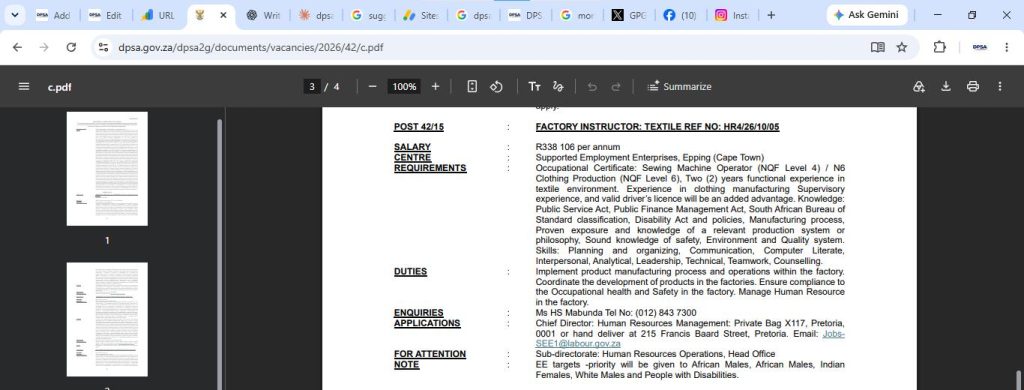
The Department of Employment and Labour has advertised a Factory Instructor: Textile position at Supported Employment Enterprises in Epping, Cape Town. The position offers an annual salary of R338,106 and requires an Occupational Certificate in Sewing Machine Operation at NQF Level 4 or an N6 qualification in Clothing Production at NQF Level 6.
Applicants must also have at least two years of functional experience in a textile environment.
The closing date is 4 December 2026. The Department accepts walk-in applications until 16:00 and online applications until 23:59.
This opportunity is relevant to people with experience in textile production, clothing manufacturing and factory operations. Applicants with supervisory experience and a valid driver’s licence will have an additional advantage.
This recruitment guide explains what the Department requires, how the qualifications relate to the advertised duties, what applicants should demonstrate in their CVs and how to submit a compliant application.
Factory Instructor: Textile Vacancy 2026, Quick Overview
| Vacancy Information | Details |
|---|---|
| Department | Department of Employment and Labour |
| Position | Factory Instructor: Textile |
| Post Number | 42/15 |
| Reference Number | HR4/26/10/05 |
| Salary | R338,106 per annum |
| Salary Level | Not specified in the supplied advertisement |
| Centre | Supported Employment Enterprises |
| Location | Epping, Cape Town |
| Minimum Qualification | Occupational Certificate: Sewing Machine Operator (NQF Level 4) or N6 Clothing Production (NQF Level 6) |
| Experience | Two years of functional experience in a textile environment |
| Closing Date | 4 December 2026 |
| Walk-in Deadline | 16:00 |
| Online Deadline | 23:59 |
| Online Application Email | JobsSEE1@labour.gov.za |
| Enquiries | Ms HS Mabunda |
| Telephone | (012) 843 7300 |
Table of Contents
- About the Department of Employment and Labour Vacancy
- Understanding the Factory Instructor: Textile Position
- Qualifications and Minimum Requirements
- What Two Years of Textile Experience Means
- Knowledge and Skills Required
- Duties and Responsibilities
- How to Demonstrate Your Experience in Your CV
- Who Should Apply for This Position?
- Salary and Workplace Information
- How to Apply
- Z83 Application Form Instructions
- Documents Required
- Employment Equity Considerations
- Selection Process and Assessments
- Common Application Mistakes to Avoid
- Important Information for Applicants
- Frequently Asked Questions
- Final Application Checklist
- Official Vacancy Source and Editorial Review
1. About the Department of Employment and Labour Factory Instructor Vacancy
The Department of Employment and Labour is recruiting a Factory Instructor: Textile for its Supported Employment Enterprises facility in Epping, Cape Town.
The advertised position involves supporting and coordinating manufacturing operations within a textile factory.
The successful candidate will be responsible for implementing product manufacturing processes, coordinating product development, ensuring occupational health and safety compliance and managing human resources within the factory.
These responsibilities require an understanding of how textile production operates, how workers perform manufacturing tasks and how factory operations maintain production and quality standards.
For example, a factory production environment involves several connected activities. Workers handle production equipment, manufacture clothing or textile products, follow production instructions and complete quality checks. Supervisors and production personnel coordinate these activities to support the required production standards.
A Factory Instructor: Textile must understand these operational activities and help ensure that factory processes run according to the Department’s requirements.
This is why the Department specifically requires textile-related qualifications and functional experience in a textile environment.
2. Understanding the Factory Instructor: Textile Position
Before applying, understand the difference between the advertised position and an ordinary sewing machine operator role.
A sewing machine operator primarily performs production tasks involving sewing equipment and garment construction.
A Factory Instructor: Textile has broader responsibilities involving manufacturing operations, product development, workplace safety and human resource management.
The successful candidate will work with factory production activities and help coordinate the processes required to manufacture products.
This distinction matters when preparing your application.
For example, an applicant who has spent two years operating industrial sewing machines should explain more than the ability to operate machinery.
The applicant should describe the production environment, the types of products manufactured, the equipment used, quality checks performed and any additional responsibilities involving production coordination or worker supervision.
These details help demonstrate how previous experience relates to the advertised position.
3. Qualifications and Minimum Requirements
The Department specifies two alternative qualifications for the Factory Instructor: Textile position.
Applicants must possess one of the following:
Option 1: Occupational Certificate in Sewing Machine Operation, NQF Level 4
This qualification relates to practical sewing machine operation and textile production activities.
Applicants with this qualification should explain their relevant practical experience, including the types of sewing equipment they have operated and the manufacturing activities they have performed.
Option 2: N6 Clothing Production, NQF Level 6
Applicants with an N6 qualification in Clothing Production should demonstrate how their education and practical experience relate to clothing manufacturing and factory production operations.
The qualification provides a clothing production background relevant to the advertised position.
Required Work Experience
The Department requires:
Two years of functional experience in a textile environment.
Applicants should ensure their CV clearly identifies their relevant employment history and responsibilities.
Added Advantages
The following are additional advantages:
- Experience in clothing manufacturing.
- Supervisory experience.
- A valid driver’s licence.
These are listed as advantages rather than compulsory minimum requirements in the supplied advertisement.
Applicants should not automatically exclude themselves because they lack one of these additional advantages if they meet the stated minimum qualification and experience requirements.
However, possessing these advantages will help demonstrate relevant experience for the advertised responsibilities.
4. What Does Two Years of Functional Experience in a Textile Environment Mean?
This is one of the most important requirements applicants should understand before submitting an application.
Functional experience refers to practical work experience relevant to the operations and activities of the advertised position.
In this vacancy, the Department specifically requires experience in a textile environment.
Relevant experience should therefore relate to activities such as:
- Operating industrial sewing machines.
- Participating in clothing manufacturing.
- Handling textile production processes.
- Following garment production specifications.
- Performing production quality checks.
- Working with textile manufacturing equipment.
- Following factory safety procedures.
- Supporting production teams.
- Coordinating manufacturing activities.
These examples explain the type of experience relevant to the vacancy. They do not replace the Department’s formal assessment of an applicant’s employment history.
Practical Example: How to Present Textile Experience
Consider an applicant who has worked in a clothing manufacturing factory for two years.
A weak CV entry might state:
“Worked as a sewing machine operator.”
This description provides limited information about the applicant’s actual responsibilities.
A stronger description, where factually accurate, would explain:
“Operated industrial sewing machines in a clothing manufacturing environment, followed garment production instructions, performed basic quality checks and worked with production team members to meet manufacturing requirements.”
If the applicant also supervised workers, the CV should explain the actual supervisory responsibilities.
For example:
“Assisted with coordinating daily production activities, monitored work progress and supported compliance with factory safety procedures.”
These examples are illustrative. Applicants should only include duties they personally performed.
The objective is to help the recruitment panel understand the nature of your experience rather than forcing the panel to interpret vague job descriptions.
5. Knowledge and Skills Required
The Department identifies specific knowledge areas and practical skills for this position.
Knowledge Requirements
Applicants should have knowledge of:
- Public Service Act.
- Public Finance Management Act.
- South African Bureau of Standards classification.
- Disability Act and related policies.
- Manufacturing processes.
- Relevant production systems or production philosophies.
- Occupational health and safety requirements.
- Environmental management systems.
- Quality management systems.
Understanding the Importance of These Knowledge Areas
Manufacturing processes
Factory production involves a sequence of activities that transform materials into finished products. Applicants should understand production operations and the importance of following manufacturing procedures.
Occupational health and safety
Textile factories use machinery and equipment that require appropriate safety procedures. Factory personnel must understand workplace safety requirements and support compliance with applicable regulations.
Environmental management
Manufacturing operations must follow relevant environmental requirements and workplace procedures.
Quality management
Quality management helps ensure manufactured products meet the required specifications and production standards.
Public Service Legislation
Knowledge of the Public Service Act and Public Finance Management Act relates to the regulatory environment within which public service operations function.
The advertisement also refers to disability legislation and policies. This knowledge is relevant to the Department’s employment equity and supported employment environment.
Skills Requirements
The Department identifies the following skills:
- Planning and organising.
- Communication.
- Computer literacy.
- Interpersonal relations.
- Analytical thinking.
- Leadership.
- Technical skills.
- Teamwork.
- Counselling.
How to Demonstrate These Skills
Instead of simply writing “good leadership skills” in your CV, provide evidence.
For example:
- Planning and organising: Describe how you arranged production activities or managed work schedules.
- Communication: Explain how you communicated production instructions to colleagues.
- Computer literacy: Identify relevant computer applications used in your work.
- Analytical skills: Describe how you identified production problems or quality issues.
- Leadership: Explain your experience guiding or supervising workers.
- Teamwork: Describe how you worked with other production employees.
Practical examples provide more meaningful evidence than a long list of unsupported personal qualities.
6. Duties and Responsibilities of the Factory Instructor: Textile
The Department identifies four main responsibilities.
6.1 Implement Product Manufacturing Processes and Operations Within the Factory
The successful candidate will implement manufacturing processes and factory operations.
This responsibility requires an understanding of production activities, operational procedures and manufacturing requirements.
In practical terms, the candidate should understand how production tasks are organised and how workers follow manufacturing instructions.
The objective is to support efficient factory operations and ensure that production activities follow the required procedures.
6.2 Coordinate the Development of Products in the Factories
The appointed candidate will coordinate product development activities within the factories.
Product development in a clothing manufacturing environment involves activities relating to product specifications, materials, production methods and manufacturing requirements.
The candidate must understand how these activities relate to the production process.
6.3 Ensure Compliance With Occupational Health and Safety in the Factory
Factory environments require appropriate workplace safety procedures.
The successful candidate will ensure compliance with occupational health and safety requirements.
Relevant responsibilities involve supporting workplace safety procedures, identifying operational safety concerns and ensuring that applicable factory safety requirements receive attention.
Applicants with experience working under factory safety procedures should explain this experience in their CVs.
6.4 Manage Human Resources in the Factory
The successful candidate will manage human resources within the factory.
This responsibility relates to the management and coordination of employees involved in factory operations.
Relevant experience in supervision, leadership, communication and teamwork will help applicants demonstrate their suitability.
Applicants with previous supervisory responsibilities should describe the size and nature of the teams they supported, where appropriate.
7. How to Demonstrate Your Experience in Your CV
A comprehensive CV is one of the two documents required for the initial application.
The Department wants an updated CV, so applicants should make sure their employment history clearly relates to the advertised position.
Use the following structure when preparing your CV.
Personal and Contact Information
Include:
- Full names and surname.
- Contact number.
- Professional email address.
- Residential location.
Avoid unnecessary personal information that the recruitment process does not require.
Educational Qualifications
List your relevant qualifications.
For example:
| Qualification | Information to Include |
|---|---|
| Occupational Certificate: Sewing Machine Operator | Institution, completion year and qualification details |
| N6 Clothing Production | Institution, completion year and qualification details |
Only include qualifications you have obtained.
Employment History
For every relevant position, provide:
- Employer name.
- Job title.
- Employment period.
- Main responsibilities.
- Relevant production activities.
- Supervisory duties, where applicable.
Practical Experience Examples
Where accurate, explain experience involving:
- Industrial sewing machine operation.
- Clothing manufacturing.
- Production coordination.
- Textile production processes.
- Quality control.
- Factory safety procedures.
- Worker supervision.
- Manufacturing equipment.
Computer Literacy
Mention the software and computer applications you have used professionally.
Do not claim proficiency in software you have never used.
Referees
Provide professional referees where appropriate, ensuring their contact information is correct and they have agreed to serve as referees.
Editorial application insight: A CV should help the recruitment panel understand why your previous work experience relates to the advertised duties. Avoid copying the entire vacancy advertisement into your employment history.
8. Who Should Apply for This Position?
This vacancy is worth considering if you:
- Hold an Occupational Certificate in Sewing Machine Operation at NQF Level 4.
- Hold an N6 qualification in Clothing Production at NQF Level 6.
- Have two years of functional experience in a textile environment.
- Understand clothing manufacturing or textile production.
- Have experience working with manufacturing equipment.
- Understand factory production procedures.
- Have relevant knowledge of workplace safety and quality requirements.
Applicants with supervisory experience, clothing manufacturing experience and a valid driver’s licence should also highlight these advantages.
Who Should Reconsider Before Applying?
You should carefully review your eligibility if:
- Your qualification is unrelated to the two qualifications listed.
- You have less than two years of relevant functional textile experience.
- Your employment history does not demonstrate work in a textile environment.
- You cannot provide the required Z83 form and comprehensive CV.
The Department’s selection panel will assess applications against the advertised requirements.
Do not assume that a general manufacturing qualification automatically meets the stated qualification requirement.
If you are uncertain about the suitability of a qualification, contact the Department using the official enquiry number provided in the advertisement.
9. Salary and Workplace Information
The advertised salary is R338,106 per annum.
The position is based at Supported Employment Enterprises in Epping, Cape Town.
| Employment Detail | Information |
|---|---|
| Employer | Department of Employment and Labour |
| Workplace | Supported Employment Enterprises |
| Location | Epping, Cape Town |
| Annual Salary | R338,106 |
| Position | Factory Instructor: Textile |
| Reference Number | HR4/26/10/05 |
The supplied advertisement does not specify the salary level or additional employment benefits. Applicants should refer to official departmental communication for further employment conditions.
10. How to Apply for the Department of Employment and Labour Factory Instructor Vacancy
The Department provides online, postal and physical hand-delivery submission details.
Applicants should prepare their documents carefully and use the correct reference number.
Option 1: Online Application
Send your application to:
Email: JobsSEE1@labour.gov.za
Your online application must contain:
- A completed, initialled and signed new Z83 application form.
- An updated comprehensive CV.
Combine the Z83 form and CV into one attachment.
Use the following email subject:
Factory Instructor: Textile, Reference Number HR4/26/10/05
Before sending your application, check:
- The correct recipient email address.
- The correct job title.
- The correct reference number.
- The completed Z83 form.
- Your updated CV.
- The combined attachment.
The online application deadline is 23:59 on 4 December 2026.
Option 2: Postal Application
Applicants submitting postal applications should use the following address:
Chief Director: Human Resources Management
Department of Employment and Labour
Private Bag X117
Pretoria
0001
Clearly identify the application with the job title and reference number.
Allow sufficient delivery time and ensure the application reaches the Department within the applicable closing period. Do not assume the postal dispatch date replaces the Department’s receipt deadline.
Option 3: Physical Hand Delivery
Applicants who prefer hand delivery should submit their applications to:
Chief Director: Human Resources Management
Department of Employment and Labour
215 Francis Baard Street
Pretoria
Attention: Sub-directorate: Human Resources Operations, Head Office.
The walk-in application deadline is 16:00 on 4 December 2026.
11. Z83 Application Form Instructions
The Department requires the new Z83 application form.
Applicants who submit the old Z83 form will not be considered.
You can obtain the form from any Public Service Department or download it from the official South African Government documents website:
How to Complete the Z83 Form Correctly
The Department provides specific instructions.
1. Complete Sections A, B, C and D
All fields in these sections must be completed in full.
2. Complete Sections E, F and G
Because of limited space on the Z83 form, applicants are allowed to indicate “Refer to CV” or “See attached” where appropriate.
However, the question in Part F concerning conditions that prevent re-appointment must be answered.
Do not leave this mandatory question unanswered.
3. Initial and Sign the Form
Ensure the application form is properly initialled and signed.
An unsigned declaration is a serious application compliance problem.
4. Use a Separate Z83 Form for Each Position
If you apply for multiple advertised posts, prepare a separate application form for every position.
Do not reuse one Z83 form for several posts.
5. Check Your Job Details
Use the correct position title:
Factory Instructor: Textile
Use the correct reference number:
HR4/26/10/05
Why the New Z83 Form Matters
The Z83 form is an official public service application document.
The Department uses the information provided to process applications and assess candidates against the recruitment requirements.
An old, incomplete or incorrectly completed application form could lead to exclusion from the recruitment process.
Review every section before submission.
12. Documents Required for the Initial Application
The Department requires only the following documents when submitting the initial application:
- Completed, initialled and signed new Z83 application form.
- Updated comprehensive CV.
For online applications, combine both documents into one attachment.
Must You Submit Certified Copies of Qualifications?
No. The supplied advertisement states that shortlisted candidates will be required to submit certified copies of qualifications and other related documents.
The Department will communicate these requirements through Human Resources.
Applicants should provide the requested documents on or before the interview date, following the Department’s communication.
Foreign Qualifications
Non-South African citizens and permanent residence permit holders who possess foreign qualifications must provide an evaluation report issued by the South African Qualifications Authority (SAQA) when shortlisted.
Failure to provide requested documents will result in the application not being considered.
13. Employment Equity Considerations
The Department of Employment and Labour is an equal opportunity affirmative action employer.
The Department intends to promote employment equity through the appointment, promotion or transfer of candidates in line with the numerical targets in its Employment Equity Plan.
The supplied advertisement identifies the following priority groups:
- African males.
- African males, repeated in the original notice.
- Indian females.
- White males.
- People with disabilities.
The African male category appears twice in the supplied advertisement. DPSACircular retains this detail transparently rather than assuming the Department intended a different category.
Applicants should refer to the original official advertisement for clarification if necessary.
Employment equity targets will be considered during the selection process.
Meeting a stated employment equity priority does not remove the requirement to meet the advertised qualification, experience and other selection criteria.
14. Selection Process and Pre-Entry Assessments
The Department requires shortlisted candidates, including Senior Management Service candidates, to undertake two pre-entry assessments.
Assessment 1: Practical Exercise
The practical exercise will determine whether candidates possess the technical and generic abilities required for the position.
For this Factory Instructor: Textile role, applicants should prepare to demonstrate relevant knowledge of manufacturing processes, textile production, quality requirements and workplace safety.
The actual assessment questions and exercise format are not specified in the supplied advertisement.
Assessment 2: Integrity Assessment
The integrity assessment will evaluate ethical conduct.
Candidates should understand the importance of professional behaviour, honesty, accountability and ethical conduct in public service.
How the Assessments Affect Selection
The selection panel will score the technical exercises as an additional criterion during the interview process.
Applicants should therefore prepare for both the practical requirements of the position and the broader responsibilities associated with public service employment.
15. Common Application Mistakes to Avoid
A well-qualified applicant might still lose consideration by failing to follow the submission instructions.
Pay attention to these common mistakes.
Mistake 1: Using the Old Z83 Form
The Department explicitly states that applications using the old Z83 form will not be considered.
Download and complete the new version.
Mistake 2: Forgetting the Reference Number
Use HR4/26/10/05 in your application correspondence.
The correct reference number helps identify the position for which you are applying.
Mistake 3: Sending Separate Online Attachments
The Department requires the Z83 form and CV as one attachment for online applications.
Combine the two documents before sending your email.
Mistake 4: Leaving the Part F Question Unanswered
The Department specifically requires applicants to answer the question concerning conditions that prevent re-appointment.
Do not use “Refer to CV” as a replacement for this mandatory answer.
Mistake 5: Submitting an Outdated CV
An outdated CV might fail to show your relevant textile experience.
Update your employment history and describe your actual manufacturing responsibilities.
Mistake 6: Waiting Until the Last Minute
Technical problems, internet interruptions and incorrect attachments create unnecessary risks.
Prepare your documents before the closing date.
Mistake 7: Applying Without Checking the Qualification Requirements
The Department identifies two specific qualification options.
Check your qualification against the original advertisement before applying.
16. Important Information for Applicants
Read these additional conditions carefully.
Late applications: Applications received after the applicable closing deadline will not be considered.
Incomplete applications: Applicants who fail to comply with the submission requirements will not be considered.
Shortlisting: Correspondence will be limited to shortlisted candidates.
Unsuccessful applications: Applicants who have not received communication within eight weeks after the closing date should regard their applications as unsuccessful.
Employment contract: Successful candidates will be required to enter into an employment contract and performance agreement.
Appointment discretion: The Department reserves the right not to make an appointment.
Personal information: By responding to the advertisement, applicants consent to the collection, processing and storage of their personal information in accordance with the Protection of Personal Information Act (POPIA). The Department states that the information will be used for the recruitment process and will not be shared with third parties without prior consent, unless required by law.
17. Frequently Asked Questions About the Factory Instructor: Textile Vacancy
1. What is the closing date for the Department of Employment and Labour Factory Instructor vacancy?
The closing date is 4 December 2026. Walk-in applications close at 16:00, while online applications close at 23:59.
2. What is the salary for the Factory Instructor: Textile position?
The advertised salary is R338,106 per annum.
3. Where is the position based?
The position is based at Supported Employment Enterprises in Epping, Cape Town.
4. What is the reference number?
The reference number is HR4/26/10/05.
5. Which qualifications are required?
Applicants must possess an Occupational Certificate: Sewing Machine Operator at NQF Level 4 or an N6 qualification in Clothing Production at NQF Level 6.
6. How many years of experience are required?
The Department requires two years of functional experience in a textile environment.
7. Is clothing manufacturing experience compulsory?
No. Clothing manufacturing experience is listed as an added advantage.
8. Is supervisory experience required?
Supervisory experience is an added advantage, rather than a stated minimum requirement.
9. Is a valid driver’s licence compulsory?
No. The supplied advertisement identifies a valid driver’s licence as an added advantage.
10. Which email address should applicants use?
Online applications should be sent to JobsSEE1@labour.gov.za.
11. Must applicants use the new Z83 form?
Yes. The Department will not consider applications submitted using the old Z83 form.
12. Must the Z83 form and CV be combined?
Yes. Online applications must include the completed Z83 form and CV as one attachment.
13. Must applicants submit certified qualifications with the initial application?
No. Certified qualifications and related documents are required from shortlisted candidates following communication from Human Resources.
14. Where should applicants deliver physical applications?
Hand-delivered applications should be submitted to 215 Francis Baard Street, Pretoria.
15. Where should applicants send postal applications?
Postal applications should be addressed to Chief Director: Human Resources Management, Private Bag X117, Pretoria, 0001.
16. Who should applicants contact for enquiries?
Applicants should contact Ms HS Mabunda on (012) 843 7300.
17. Will shortlisted candidates undergo assessments?
Yes. Shortlisted candidates will complete a practical exercise and an integrity assessment.
18. Does the Department consider employment equity?
Yes. The Department will consider employment equity targets during the selection process.
19. Will unsuccessful applicants receive individual feedback?
The Department states that correspondence will be limited to shortlisted candidates. Applicants who have not received communication within eight weeks after the closing date should regard their applications as unsuccessful.
20. Does DPSACircular.co.za accept applications for this vacancy?
No. DPSACircular.co.za provides independent government vacancy information and application guidance. Applicants must submit their documents directly to the Department of Employment and Labour.
18. Final Application Checklist
Before submitting your application, use this checklist to review your documents.
Qualification and Experience
- I have an Occupational Certificate in Sewing Machine Operation at NQF Level 4 or an N6 qualification in Clothing Production at NQF Level 6.
- I have two years of functional experience in a textile environment.
- I have included relevant employment information in my CV.
- I have highlighted additional advantages where applicable.
- I have downloaded the new Z83 form.
- I have completed Sections A, B, C and D.
- I have answered the mandatory Part F question.
- I have initialled and signed the form.
- I have used a separate Z83 form for this position.
CV and Supporting Documents
- I have prepared an updated comprehensive CV.
- My CV explains my relevant manufacturing experience.
- My contact details are correct.
- My employment dates and qualifications are accurate.
Submission Details
- I have used the correct job title.
- I have included reference number HR4/26/10/05.
- I have combined my Z83 form and CV into one attachment for online submission.
- I have checked the recipient email address.
- I will submit before the applicable closing deadline.
19. Official Vacancy Source and Editorial Review
Source of Vacancy Information
This article is based on the Department of Employment and Labour Factory Instructor: Textile vacancy information supplied for Post 42/15, reference number HR4/26/10/05.
The recruitment requirements, salary, duties, application instructions and closing times in this article reflect the supplied vacancy notice.
Applicants should consult the original official advertisement and any subsequent departmental communication before submitting their applications.
Official Z83 application form resource:
How DPSACircular.co.za Prepared This Article
DPSACircular.co.za prepares government vacancy guides by organising advertised recruitment information into practical sections for job seekers.
For this vacancy, the editorial process involved:
- Identifying the advertised position, reference number, salary and workplace.
- Separating compulsory qualification and experience requirements from added advantages.
- Organising the four advertised duties into understandable explanations.
- Reviewing the Z83 instructions and identifying mandatory application requirements.
- Separating online, postal and physical hand-delivery submission details.
- Explaining the selection assessments and employment equity information.
- Adding practical CV guidance and examples to help applicants understand how their experience relates to the position.
The practical examples in this article are editorial illustrations, not statements from the Department or reports of interviews with its recruitment personnel.
The original vacancy advertisement takes precedence if any difference arises between the official notice and this explanatory guide.
About the Author
Godwin Samuel
Founder and Publisher, DPSACircular.co.za
Godwin Samuel has more than eight years of experience in employment research, recruitment guidance and job information publishing.
His editorial responsibilities include researching government employment opportunities, explaining public service application requirements, reviewing vacancy information and updating published articles when departments issue corrections or recruitment changes.
His work focuses on helping applicants understand qualification requirements, employment conditions, application documents, closing dates and official submission procedures.
Read more about the publisher on the DPSACircular.co.za author profile.
Editorial Disclaimer
DPSACircular.co.za is an independent South African job information website. We are not affiliated with, endorsed by or connected to the Department of Employment and Labour, the Department of Public Service and Administration (DPSA) or any South African government department.
We do not accept or process job applications, shortlist candidates, conduct interviews, select employees or participate in government recruitment decisions.
We do not guarantee employment, shortlisting or appointment.
All applications, recruitment decisions and employment processes remain the responsibility of the relevant government department.